Data Engineering Career Path

Fully funded training. We’ll help you land your first professional role

What Does a Data Engineer Actually Do?

In an era where AI, Machine Learning, and Big Data are the core of every technological product, Data Engineers are the ones who support the entire infrastructure.

A Data Engineer is responsible for the systems that support all data processes. This core role in modern development teams connects systems, products, and people. They are responsible for building, deploying, and maintaining systems that handle data ingestion, storage, and processing in an organization.

Typical responsibilities include:

  • Designing and building data infrastructure
  • Collecting, storing, processing, and transporting data
  • Developing and maintaining data pipelines
  • Working with raw, complex, unstructured data
  • Ensuring reliability, availability, and scalability of data systems
  • Collaborating with development, AI, BI, and DevOps teams

This role sits at the intersection of software engineering and DevOps, requiring deep technical expertise, systems thinking, and problem-solving skills.

Without Data Engineers – there is no infrastructure, no data, and no ability to transform data into business value.

The Difference between a Data Engineer, Data Scientist, and Data Analyst

Although all three roles work with data, they represent completely different stages in the data workflow:

Data Engineer

Responsible for the infrastructure:
  • Works with data at its earliest stage
  • Builds systems that make data usable
  • Ensures data is available, reliable, and ready for use

Data Analyst

Responsible for analysis:
  • Works with already processed data
  • Produces reports, insights, and analysis
  • Supports business decision-making

Data Scientist

Responsible for model and forecasts:
  • Uses data to build advanced models
  • Works with AI and Machine Learning
  • Generates predictions and deep insights

Data engineers are key partners, working alongside data scientists and data analysts to make their work more efficient and effective.

In summary:

  • Data Engineers build the foundation
  • Data Analysts analyze the data
  • Data Scientists produce intelligent models

While Analysts and Scientists work with existing data, Data Engineers ensure that data exists, is reliable, and is accessible.

Data Engineering is a critical, in-demand and highly impactful role. In an era where AI and data are the heart of every product, without a Data Engineer, there would be no data to work with.

About the Program

The Data Engineer role is one of the core positions in the world of data and AI. Data Engineers are responsible for designing, developing, and maintaining complex data infrastructures that enable organizations to work with large volumes of information, build intelligent models, and make data-driven decisions.

The Data Engineering career track at Infinity Labs R&D is an intensive, in-depth 22-week training program designed for bachelor’s degree graduates who want to become leading Data Engineering experts in the industry.

During the training, you will progress through three stages:

  • Software Engineering Foundations
  • Big Data Systems and Architecture
  • Systems Integration and Applied Data Engineering

You will learn to apply this knowledge through real-world projects, working at the pace and standards of high-tech research and development teams.

Throughout the program, our client relations department and your mentors work intensively to secure your first position – typically a role requiring 2–3 years of experience. Over the past decade, Infinity Labs R&D has found jobs for more than 2,500 graduates at top-tier Israeli companies.

Duration

22 weeks Sunday - Thursday 08:30-18:30

Location

Jabotinsky 1 Ramat Gan next to Savidor Merkaz train station

Free of charge

A unique WIN-WIN-WIN model, where we help you secure your first job with one of our 300+ client companies

The training takes place at the Infinity Labs R&D offices, located in the heart of the Bursa District in Ramat Gan, within walking distance of Savidor Center train station.

The location provides convenient access from Tel Aviv, the greater Gush Dan area, the Sharon region, and the Shfela, as well as easy access for participants arriving from the north and south of the country via train and public transportation.

What You Will Learn

From Software Engineering to Large-Scale Data Systems

The Infinity Labs R&D Data Engineering track is structured as a progressive training process that equips participants to design, develop, and operate data systems like professional Data Engineers.

The program begins with fundamental software engineering skills, advances through Big Data architectures, and culminates in building production-grade, end-to-end data systems.

Below is an overview of the program’s key training areas and core principles.

In-depth technical breakdown is available in the full syllabus.

Stage 1: The Data Engineer's Work in Software Engineering Foundations

The first stage focuses on building the stable, reliable, and scalable software development infrastructure that is the foundation of all modern data systems. Participants develop a systems-engineering mindset, learning how code behaves under load, integrates with infrastructure, and remains readable, efficient, and maintainable over time.

Learning is hands-on, accomplished through practical projects that simulate industry standards, with an emphasis on code quality, testing, automation, and end-to-end ownership.

Key topics:

  • Procedural and object-oriented programming in Python
  • Algorithms and data structures
  • Working in Linux, Shell and Bash
  • Developing APIs and designing interfaces for data services
  • Code complexity analysis and performance optimization
  • Software testing (unit, regression, smoke)
  • Advanced debugging and dependency management
  • CI/CD, containerization and deployment automation
  • Developing industrial-grade products with full traceability
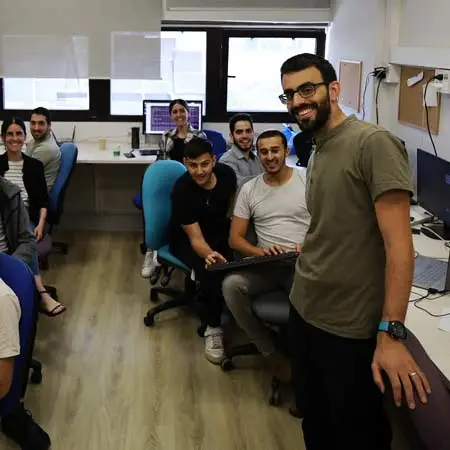
Participants working in development teams during the Infinity Labs training program
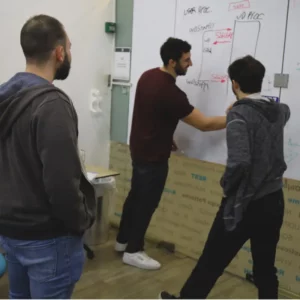
Participant during technology training with mentors at Infinity Labs

Stage 2: The Data Engineer's work with Data Architecture and Big Data: the data infrastructure behind the products

The second stage moves from focusing on individual components to taking a broad, systemic view. Participants learn to build data pipelines and design large-scale data infrastructures: understanding how data flows, changes, and scales in distributed environments, while designing systems capable of handling large volumes of information and complex operational challenges.

The emphasis is on engineering real-world data pipelines and working with distributed systems, batch processing and streaming architectures, as practiced in technology, fintech, and AI companies.

Key topics:

  • Collecting data from structured and unstructured sources
  • SQL and NoSQL, multi-model storage
  • DBMS design and optimization for large-scale performance
  • Distributed Processing with Apache Spark, PySpark, and ELK Stack
  • ETL/ELT processes and DAG-based Workflows
  • Batch and real-time streaming architectures
  • Data modeling, storage, and cloud data warehousing
  • Message queues and event-driven integrations
  • Orchestration, scheduling and automation
  • Data governance, security and regulatory compliance
  • Using cloud tools for efficient, durable, and cost-effective solutions

Stage 3: The Data Engineer's Work in Systems Integration and Applied Data Engineering: Building an End-to-End Production System

In the final stage, participants integrate all components into a full production system. They design, implement, and maintain production-grade data systems, simulating full responsibility for reliability, availability, and accuracy—just like professional Data Engineers in the industry.

The stage emphasizes ownership, engineering decision-making, and addressing real challenges in live systems.

Key focus areas:

  • Authentication and authorization management in distributed systems
  • Data governance and data integrity controls
  • Event-driven architectures and message queuing
  • Ingestion, partitioning, and reprocessing strategies
  • Error handling, backfilling, and data versioning
  • Scalable storage planning and lineage tracking
  • Orchestration frameworks and dependency resolution
  • Observability, monitoring, and alerting
  • Building analytical layers to extract insights from operational data
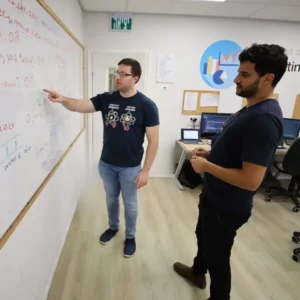
Participant during hands on technology training at Infinity Labs
What You Will Learn
From Software Engineering to Large-Scale Data Systems

The Infinity Labs R&D Data Engineering track is structured as a progressive training process that equips participants to design, develop, and operate data systems like professional Data Engineers.

The program begins with fundamental software engineering skills, advances through Big Data architectures, and culminates in building production-grade, end-to-end data systems.

Below is an overview of the program’s key training areas and core principles.

In-depth technical breakdown is available in the full syllabus

Stage 1: The Data Engineer's Work in Software Engineering Foundations

The first stage focuses on building the stable, reliable, and scalable software development infrastructure that is the foundation of all modern data systems. Participants develop a systems-engineering mindset, learning how code behaves under load, integrates with infrastructure, and remains readable, efficient, and maintainable over time.

Learning is hands-on, accomplished through practical projects that simulate industry standards, with an emphasis on code quality, testing, automation, and end-to-end ownership.

Key topics:

  • Procedural and object-oriented programming in Python
  • Algorithms and data structures
  • Working in Linux, Shell and Bash
  • Developing APIs and designing interfaces for data services
  • Code complexity analysis and performance optimization
  • Software testing (unit, regression, smoke)
  • Advanced debugging and dependency management
  • CI/CD, containerization and deployment automation
  • Developing industrial-grade products with full traceability
Participants working in development teams during the Infinity Labs training program
Stage 2: The Data Engineer's work with Data Architecture and Big Data: the data infrastructure behind the products

The second stage moves from focusing on individual components to taking a broad, systemic view. Participants learn to build data pipelines and design large-scale data infrastructures: understanding how data flows, changes, and scales in distributed environments, while designing systems capable of handling large volumes of information and complex operational challenges.

The emphasis is on engineering real-world data pipelines and working with distributed systems, batch processing and streaming architectures, as practiced in technology, fintech, and AI companies.

Key topics:

  • Collecting data from structured and unstructured sources
  • SQL and NoSQL, multi-model storage
  • DBMS design and optimization for large-scale performance
  • Distributed Processing with Apache Spark, PySpark, and ELK Stack
  • ETL/ELT processes and DAG-based Workflows
  • Batch and real-time streaming architectures
  • Data modeling, storage, and cloud data warehousing
  • Message queues and event-driven integrations
  • Orchestration, scheduling and automation
  • Data governance, security and regulatory compliance
  • Using cloud tools for efficient, durable, and cost-effective solutions
Participant during technology training with mentors at Infinity Labs
Stage 3: The Data Engineer's Work in Systems Integration and Applied Data Engineering: Building an End-to-End Production System

In the final stage, participants integrate all components into a full production system. They design, implement, and maintain production-grade data systems, simulating full responsibility for reliability, availability, and accuracy—just like professional Data Engineers in the industry.

The stage emphasizes ownership, engineering decision-making, and addressing real challenges in live systems.

Key focus areas:

  • Authentication and authorization management in distributed systems
  • Data governance and data integrity controls
  • Event-driven architectures and message queuing
  • Ingestion, partitioning, and reprocessing strategies
  • Error handling, backfilling, and data versioning
  • Scalable storage planning and lineage tracking
  • Orchestration frameworks and dependency resolution
  • Observability, monitoring, and alerting
  • Building analytical layers to extract insights from operational data

Inside the Training Experience

The Data Engineering career track is built around the Infinity Mentored Social Learning (IMSL™) methodology, an approach developed over the years to simulate the experience of working within a real R&D team.

Participants work in small groups of about 14 students, guided by an experienced Tech Leader from the R&D and Data fields. The learning process focuses on tackling complex problems, conducting independent research, running systematic experiments, writing production quality code, and critically evaluating results.

There are no frontal lectures, no passive learning, and no traditional exams. Success is measured by the ability to take a complex Data problem, break it down, explore different approaches, implement solutions, measure outcomes, and arrive at a high quality result within a defined timeframe.

Learning Principles

  • 100% hands on learning: every topic is taught through real projects
  • A spiral learning process: Challenge → Research → Experiment → Apply → Test → Evaluate
  • Small teams that simulate an industrial R&D environment
  • Ongoing guidance from active Tech Leaders from the industry

The program takes place five days a week, Sunday to Thursday, from 08:30 to 18:30, at the Infinity Labs R&D labs in Ramat Gan.

This is a full time and intensive training program. In most cases, it does not allow participants to work in parallel, due to the level of commitment and depth required.

Who This Program Is For

The Data Engineering track is suitable for bachelor’s degree graduates in STEM fields (Computer Science, Physics, Mathematics, Neuroscience, Engineering, etc.), as well as graduates in Economics, Accounting, or any academic degree with strong academic performance. We seek highly capable, self-driven individuals who are ready to work hard to build a professional career in Data Engineering.

The role is also well-suited for individuals with strong critical thinking, communication skills, and the ability to make information accessible while providing solutions and support. Data Engineers interact daily with multiple parts of an organization.

Key soft skills:

  • Critical thinking
  • Good communication
  • Problem-solving
  • Ability to present information clearly
  • Willingness to work hands-on with data
  • Customer-service mindset

The training program takes place at Infinity Labs R&D offices in Ramat Gan, Jabotinsky 1, in the heart of the stock exchange – a short walk from Savidor Merkaz station, accessible by train and public transportation from Tel Aviv, Gush Dan, Sharon, and Shfela.

Admission Requirements

To maintain the depth and intensity of the program, the admission requirements are clearly defined:

A Bachelor’s degree in engineering, exact sciences, computer science, economics, or accounting

OR a bachelor’s degree from a recognized university with high academic results

Successful completion of a technical aptitude test and an assessment day, including an HR interview to evaluate personal fit and motivation

These requirements ensure that the program maintains the level of depth, pace, and professional standards required for training Data Engineers for industry.

Data Engineering Roles Our Graduates Pursue

Graduates join core data teams in high-tech companies, startups, banks, defense organizations, and other data-intensive environments. Thanks to the program’s practical and in-depth training, they work on designing, developing, and maintaining data infrastructures and production systems.

Graduate roles include:

  • Data Engineer
  • Big Data Engineer
  • Data Infrastructure Engineer
  • Data roles in development, BI, and AI teams

In practice, graduates work on the infrastructures that power digital products, algorithms, analytics systems, and AI applications, often in complex, large-scale environments.

The following examples are based on real graduate stories and data from the field.

Data Engineering Career Track vs. Short AI Courses

Data Engineering is not just a set of tools — it is a meaningful profession that forms the basis of all data systems, which are the foundation of modern technology.

Short courses often focus on learning specific tools, whereas our career track prepares you to work as a professional Data Engineer in environments that simulate real industry conditions.

Our program emphasizes the full ecosystem of data systems — not only technical skills, but also systems thinking and effective communication with both those who produce raw data and those who consume it.

And what about your first job? We take care of that too. Throughout the training program, leading companies from among our 300+ partners interview you for your first Data Engineer role, which typically requires 2–3 years of experience.

For those seeking a data course or general data studies, this program offers much more — a complete retraining and specialization track designed to build a long-term, stable, and rewarding career.


What Makes the Infinity Labs
Data Engineering Program Unique

Graduates successfully trained for a career in high-tech
0 +
Graduates employed in leading high-tech jobs
0 %
High tech companies employ our graduates
0 +
Groups trained in high-tech professions
0 +

Infinity Labs R&D is a research and development company founded in 2014 that prepares university graduates for careers in high tech through a training environment designed to simulate real industry R&D teams. The program is conducted in small groups of about 14 participants, guided by an experienced Tech Leader, and focuses on working on complex projects at an industrial level.

Students are carefully selected based on their academic background and strong quantitative abilities. During the program, they develop systemic thinking, independent problem solving skills, and the ability to work within Data Engineering and Data platform teams at leading organizations.

To date, more than 2,500 graduates have joined roles that typically require 2 to 3 years of prior experience, across over 300 high tech companies, defense organizations, and leading development centers.

The combination of deep technological training, work in a real R&D style environment, and a comprehensive placement framework is what differentiates Infinity Labs from other training programs.

Key Advantages

  • Elite training in Data Engineering and data systems, designed for individuals with strong analytical abilities who aspire to build and operate large scale data infrastructure
  • Active Tech Leaders from the R&D and Data Engineering fields who guide the training on a daily basis
  • Placement often begins during the program, with the option for a focused internship at the end as preparation for the role
  • A WIN WIN WIN model: the training is free for accepted candidates, and the company succeeds only when graduates integrate successfully into long term roles
  • Comprehensive career and placement support, including connections with hundreds of companies and continued guidance even after graduates begin working

AI Researcher Program FAQ

How long is the Data Engineer program?

The Data Engineer career track at Infinity Labs R&D is an intensive 22 week training program that takes place five days a week at the company’s Ramat Gan labs. The program focuses on building production ready data systems and infrastructure used in modern data driven organizations.

The program is designed for university graduates in STEM fields such as computer science, mathematics, physics, engineering and other analytical disciplines who want to specialize in building data infrastructure and large scale data systems.

Data Engineers design and build the infrastructure that enables organizations to collect, store and process large volumes of data. Their work includes building data pipelines, managing databases, working with distributed systems and ensuring that data is accessible for analytics, machine learning and business applications.

Data Engineers focus on building the data infrastructure and pipelines that make data available and reliable. Data Scientists focus on analyzing that data, building predictive models and extracting insights. Both roles work closely together in modern data teams.

Data Engineers combine software engineering skills with knowledge of data infrastructure. Important skills include Python programming, SQL, data pipeline development, distributed systems, cloud platforms and system architecture. Strong analytical thinking and problem solving skills are also essential.

Data Engineers commonly work with technologies such as Python, SQL and NoSQL databases, Apache Spark, Kafka, ETL pipelines, distributed data systems and cloud platforms used to store and process large scale data.

Graduates of the program typically pursue roles such as Data Engineer, Big Data Engineer, Data Platform Engineer and Data Infrastructure Engineer in technology companies, startups and large organizations.

The training is free for accepted candidates as part of the Infinity Labs R&D training model.

Ready to Become a Data Engineering Leader in Israel?

If you are a STEM graduate with strong analytical skills and an ambition to build large scale data systems, the Data Engineering career track at Infinity Labs R&D was designed for you.

Training is provided at our expense

Infinity also offers a low-interest loan for trainees through Bank Leumi

up to 50,000 NIS to help with living expenses. Payable upon start of employment or after 1 year.

Leumi logo
Infinity logo

Our Graduates’ Stories

Customer Recommendations

Leave your details and we will get back to you as soon as possible

*Preferred training location
*Did you specialize in computer science or the exact science in high school?
*Are you willing to undergo security clearance?
Please upload your CV (recommended):
By submitting your application, you confirm that you have read and agree to our Privacy Policy.